When Subjectivism Drives History: What Interpretation of the Jefferson-Hemings DNA Says About the History Profession
The DNA tests of members of the Jefferson and Hemings families, it has been argued by many, proves that Thomas Jefferson fathered a child with his slave Sally Hemings. The contents of this web page look at the evidence, including areas of the claim where there are weaknesses.
The first video on this web page presents virtually all of the information found in the other contents of the page.
(below:) Here is a shorter version of the first video. This version runs under three minutes. The shorter version contains most or all of the key facts, but lacks the discussion of the deeper trends which allow for the facts to be misrepresented.
These two videos are also posted on YouTube at https://www.youtube.com/watch?v=sGCz9xd-qdI and https://www.youtube.com/watch?v=HoAF4OG_Xvc. Visitors to those pages may leave comments. If the YouTube videos are not functioning here, go to the bottom of this page, where the two videos can be played from an alternative server.
The remainder of this page is mostly the text counterpart of the longer video. Beginning with the next paragraph, the text presents the script of the video, alongside key illustrations.
[next: video timepoints of 0:00 to 0:43]
If you wonder how a scholar can come to propagate just one of the claims and eschrew the others, you are about to see a historian give an indication. |
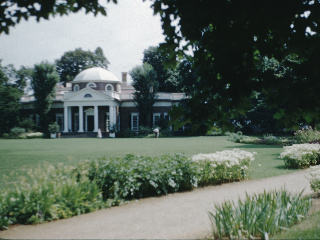 A 1998 journal article reported on findings from DNA associated with Thomas Jefferson and of Jefferson’s slave Sally Hemings. Findings validated — not proved, but validated — claims that Jefferson may have fathered some Hemings children, but scholarly responses stated why the same DNA would also fit links of lineage that would bypass Thomas Jefferson and instead lead to other men in his family. These other male Jefferson relatives were regularly at his Monticello plantation at times that Hemmings became pregnant.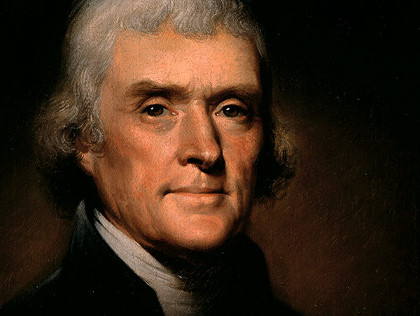
[next: video timepoints of 0:43 to 2:38]
[In the longer video, the first two paragraphs of narrated content (above) are followed by a minute and fifty-five seconds of video excerpted from a panel discussion. Catherine Kerrison, author of “Jefferson’s Daughters: Three Sisters, White and Black, in a Young America,” is here interviewed by Eric Deggans of National Public Radio (NPR). In promotional materials for the panel discussion issued prior to the 2018 event, the host organization stated, “Catherine Kerrison is an associate professor of history at Villanova University in Villanova, Pennsylvania, where she teaches courses in colonial and revolutionary America and women’s and gender history. She holds a Ph.D. in American history from the College of William and Mary. Her first book, Claiming the Pen: Women and Intellectual Life in the Early American South (Cornell), won the Outstanding Book Prize from the History of Education Society in 2007. She has recently written Jefferson’s Daughters: Three Sisters, White and Black, in a Young America (Ballantine).”
[Kerrison takes the position that Jefferson fathered children with Hemings. Toward the end of the included clips (the full event ran forty-eight minutes), Kerrison remarks, “ultimately, in seeing the humanity of our founders, I think that is actually kind of freeing and liberating — so we don’t have to (sort of) feel as though we have to live up to these towering idols ...”]
[2:38 to 2:56]
The professor’s admission that she feels better believing Jefferson to be not as impressive as his best reputation, invites comment. That subject will come after discussion about the specimens examined.
What is the evidence that she or historians on the other side of the dispute have? DNA was not collected from Thomas Jefferson himself. No DNA was used from any direct descendant, because the scientific test used requires an unbroken line of male descendants, so as to test for markers on a Y chromosone passed from father to son. There is no such line from Thomas Jefferson.
[While the narration tells of DNA not having been collected from Thomas Jefferson, and while the narration states that there is no such line from Thomas Jefferson, the picture of the video displays two titles which report the facts which explain why the lack of DNA collection and lack of an unbroken line: (1) No DNA was taken from Thomas Jefferson — not from his grave nor any artifact left behind from his time. (2) No established son of Thomas Jefferson lived long enough to leave children.]
[As the next paragraph of narration is read in the videos (both long and short versions), the image in the video is of the family tree show below, which is a family tree of Thomas Jefferson and his relatives. This family tree is gradually annotated by repetitions of two symbols:
 = a Jefferson male with the relevant Y chromosone;
 = a Jefferson-family male without that Y chromosone.
[For the reader’s convenience, these additional symbols are permanently in place:
 = a male (always shown in blue);
 = a female (always shown in pink).
[The “Y” and “NO” (slash inside a circle) markers are laid down on the image next to the tree positions of the Jefferson relatives as specified relationships are mentioned. Although the same tree and animation are shown in the GIF below, it was not possible on a web page to time the markers to appear in synchronization with visitors’ reading speed. Readers who are willing to click through the separate developments as part of a slide-show will find the slide-show equivalent of this animation a short distance below. The text immediately below the animation-annotated tree discusses the chain-of-evidence depicted in the animation; the same text is reproduced development-by-development in the slide-show that follows..]
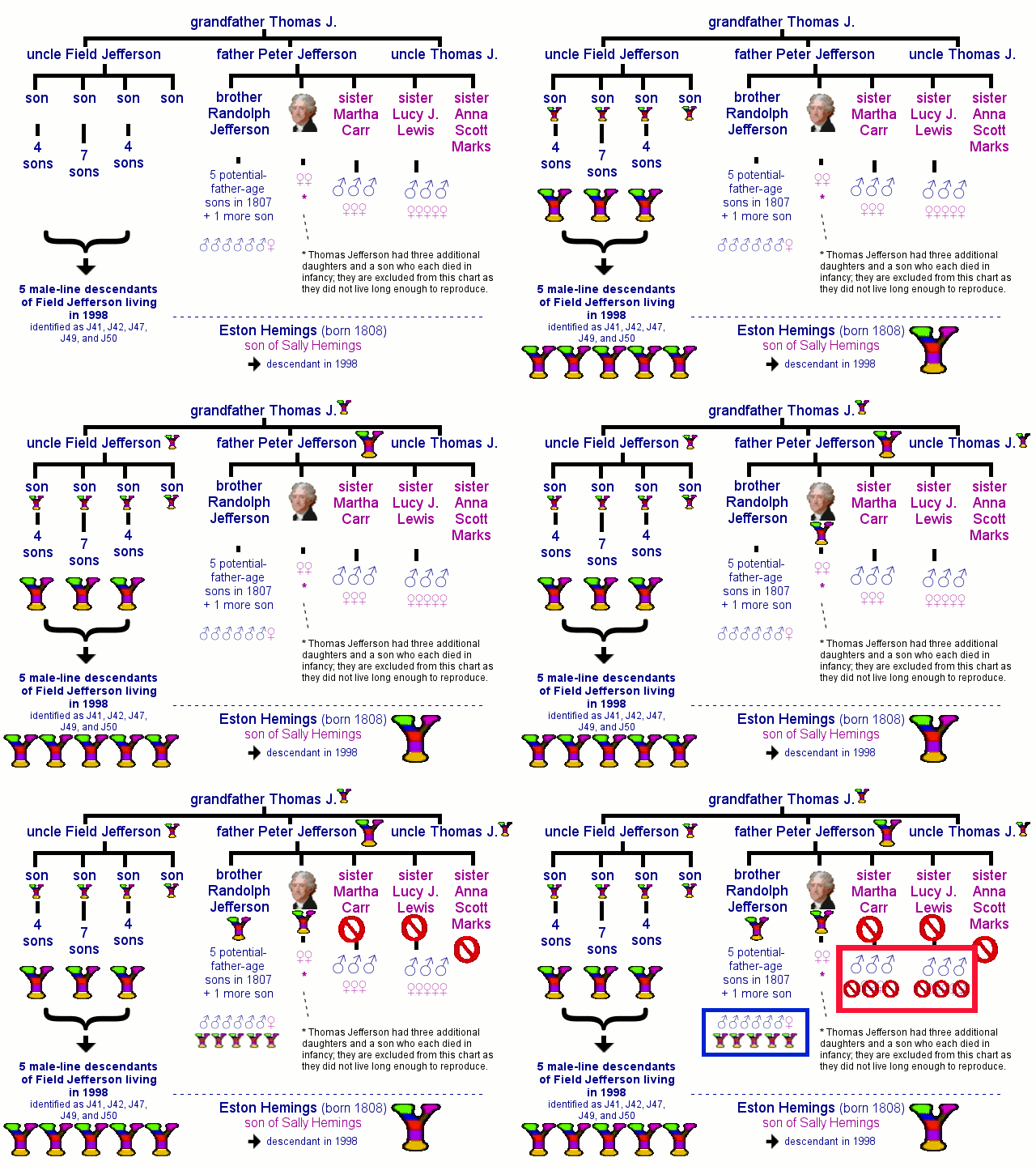
Scientists were able to match the Y chromosone of one descendant of one Hemmings child to the Y chromosone of descendants of Thomas Jefferson’s uncle [see bottom of GIF image], meaning that the Y chromosone would have been passed to that uncle from Thomas Jefferson’s grandfather [see left side of GIF], who passed it also to Thomas Jefferson’s father and yet another of the father’s brothers. Thomas Jefferson’s father passed it to the future President [identified by his picture] and to the President’s brother, meaning that the chromosone also went into that brother’s five sons, who lived near Monticello. Thomas Jefferson’s three sisters would not be carriers of the Y chromosone, so Jefferson’s nephews the Carr brothers would not have it. There were yet many potential fathers among the male Jefferson relatives; some nephews would pass along the Y chromosone [those inside blue box], some would not [those in red box].
[In the above graphic, some nieces are shown on the family tree with the traditional “female” symbol (a circle with a plus sign attached at bottom) indicating their relation, but neither the “Y” nor “NO” symbol (slash inside a circle) accompanies them, inasmuch as females could not pass the relevant chromosone.]
[Next on this page is the slide-show counterpart of the animation. Click where indicated to proceed through the steps.]
[3:56 to 5:20]
Some people assume that proof of paternity was established in the 1998 article by which the public first learned of the DNA evidence, and think that all they have to do to argue that paternity was established, is to point out that that article in a November 1998 issue of Nature was titled “Jefferson Fathered Slave’s Last Child.”
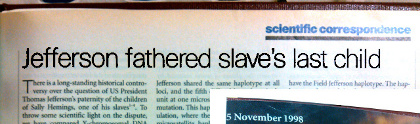
Those who do read the article find no statements which declare what the title had. The team of scientists and pathologist who were the researchers and authors of the article wrote a letter published in a subsequent issue of “Nature” in which they state that Jefferson’s paternity was not established, and they refer to the article title having been “assigned” by the journal. The journal printed their statement and did not add any defense, even though editors sometimes do dispute the authors of letters in space underneath the letters they print.
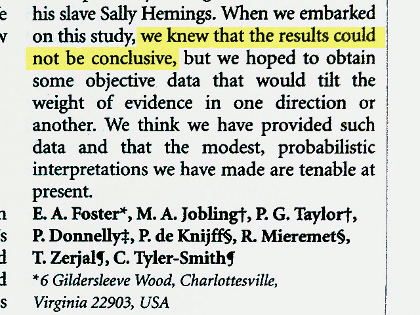
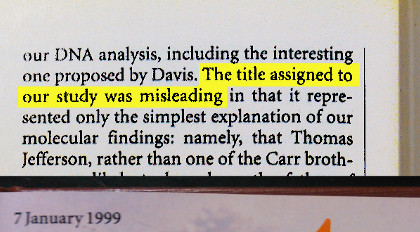
The pathologist who was the lead author also put on record his determination that paternity had not been proved, in a letter he wrote published in The New York Times just days after the issue date of the Nature article. The New York Times had circulation many, many times that of Nature, and its readership had great influence on what was repeated in the press elsewhere.
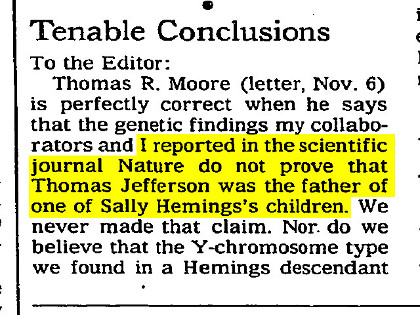
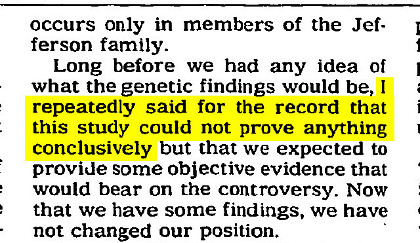
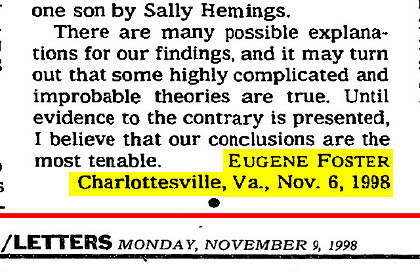
(The combination of the two letters should have alerted cautious thinkers who seek accuracy that there were serious grounds not to accept the interpretation of the DNA findings first published.)
|
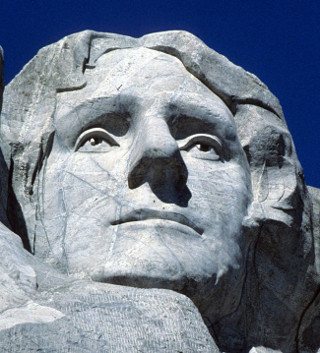 A listener has grounds to wonder whether a speaker is concerned with the known facts when you hear something like [at this point the video repeats the audio of the professor as she says:] “I think that is actually kind of freeing and liberating — so we don’t have to (sort of) feel as though we have to live up to these towering idols”.
[5:20 to 5:51]
A term that used to be part of popular culture was “feet of clay” — to express a desire that there not be people who set examples which less-exacting people become blindingly uncomfortable with when making comparisons to themselves.
image: Immanuel Kant |
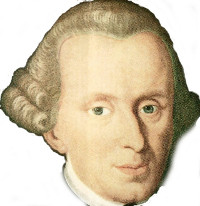 Objectivist intellectuals understand that underlying some such occurrences are philosophic skepticism, deference to social institutions in place of objectively-perceived reality, and a succession of corruptions in Western culture traceable to Immanuel Kant.
[5:51 to 8:13]
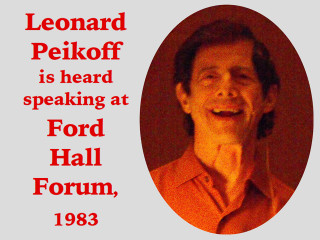 [At this point in the video, a lengthy audio clip is heard, excerpted from a 1983 speech given at Ford Hall Forum by Dr. Leonard Peikoff, who had by this point a decades-long career as a college professor, and who had the previous year published a book of intellectual history. Four photographs of the professor, photographed in 2010, accompany the audio. The speech is titled “Assault from the Ivory Tower: The Professors’ War Against America.” The war mentioned in that title, he explained in the talk itself, “is not a political or anticapitalist war as such” but an “assault against the founding philosophy of this country that is now being conducted by our universities.” Dr. Peikoff is a leading intellectual among Objectivists, a long-time friend of Ayn Rand, who created the philosophy of Objectivism.]
[Editor’s note: In the first sentence of the content quoted from the speech, “Kantian” refers to the ideas of Immanuel Kant.]
If you want to see both Kantian elements—skepticism and the worship of the social—come together, consider the field of history today. Here is an excerpt from a course description at the University of Indiana (Bloomington); the course is titled “Freedom and the Historian.”
History is made by the historian. Each generation of historians reinterprets the past in the light of its own historical experience and values .... There can be thus no one definitive history of Alexander and no one historical truth about the fall of the Roman Empire .... There have been as many concepts of history, as many views of historical truth, as there have been cultures.
The skeptical theme here is clear—there is “no one definitive history,” “no one historical truth.” An old-fashioned person, even a skeptic, would react: “Well, then, let’s close down the field, if we can’t know the truth.” But not the moderns. We can’t know the real truth, they say, but we can know the subjective truth that we ourselves create. “History is made by the historian.” If there is a consensus of historians, therefore, their viewpoint is valid and worth studying, for that time and culture. As in Kant, there are two realities: the real past (which is unknowable), and the private world each generation creates, its own subjective historical truth. Notice that in this viewpoint the historian is at once helpless and omnipotent: he can know nothing really; but on the other hand he is the creator of history, of the history that we can know, and so he is an unchallengeable authority. If any student disagrees with the fraternity of historians, therefore, he has no chance. On the one side, he hears: “Who are you to know? There are no definitive facts.” On the other, he hears: “History is made by the historian. Who are you to question it?”
Observe what people allow themselves when hiding behind a group. If the author of that course description were to say: “History is made by me,” he would be dismissed as a paranoid personality. But when he says it collectively: “History is made by us, by our guild, by historians,” that is acceptable. This is the Kantian exaltation of the social (generated by Kant).
[This completes the first of two excerpts in this video of audio from Peikoff’s lecture.]
[8:13 to 9:03]
|
 In the Objectivist approach to reasoning and thus to scholarship in all its forms, there are definitive facts; a human being using an objective approach can know what is true; and people from differing backgrounds can use rational methods to discover truth, and share and accept single unifying explanations about what those true facts mean. Any rational person knowing that he is not guilty of a murder would want police to keep investigating if the police discovered that DNA evidence left on a victim merely has some aspects of one’s own DNA. Likewise, a rational person concerned with the direction of his culture should want university faculty to take a proper facts-oriented approach when investigating the artifacts of history.
[9:03 to 10:03]
Pleas were advanced just after the DNA findings that Jefferson’s reputation should be reframed as having fathered slaves’ children because the reframing — it was said — would be good for race relations now. Never mind that race relations have improved markedly in the two centuries since Jefferson’s time. What gets lost in the reframing machinations is that the best way for individuals and groups of every kind to get along well is to be united on looking at facts as the basis of conclusions. A reasoned understanding of the facts had not been what was most frequently used to establish Jefferson’s culpability since 1998. An understanding based on reason is far from what comes from the modern historians who are so eager for there to be a prominent villain or hero that they (in effect) “draft” Thomas Jefferson to be bogeyman or trendsetter; this occurs even when such historians seek only to please a particular historian’s limited audience. Dr. Peikoff addresses this point in a passage that follows immediately from the excerpt just heard from him.
[10:03 to 11:09]
There is a further development of the Kantian approach here. Why, historians soon began to ask, should the social authority be universal? Why can’t there be many groups of historians, each creating history in accordance with its own mental structure, each version being true for that group though not for the others? Why, in effect, shouldn’t we be democratic and let every collective into the act? The result of this line of thinking is pressure-group history, a pluralization of the Kantian approach, in which each group rewrites the past according to its own predilections, and every group’s views are deemed to be as valid (or invalid) as every other group’s. To be progressive in history today means precisely this: it means to respect the rewriting of all the newest groups, especially if they make no sense to you; that shows that you are open-minded, and are not trying to impose your group’s private views on others. To each his own subjectivism (in effect).
[This lecture was delivered at the Ford Hall Forum on April 24, 1983, and first published in The Objectivist Forum issues of October and December 1983. The print version of the lecture has been easily obtainable from mass-market booksellers through its inclusion in the book The Voice of Reason: Essays in Objectivist Thought, which credits Ayn Rand as principal author and Peikoff as editor and for additional essays, published by New American Library, 1989. Though the print version was used in the preparation of this video and web page for guidance in punctuation, the text used in the video subtitles and this web page has been adapted to provide the word choices used in the spoken version in the few instances where wording in the live spoken presentation differs slightly from the published version. The following differences were noted when the lecture audio and published text were compared: (1) the lecture has “even a skeptic” where the published version says “even of a skeptic mentality”; (2) the lecture has “the real past (which is unknowable)” where the published version says “the real past (unknowable)”; (3) the lecture has “private world each generation creates” where the published version says “private past each generation creates”; (4) the lecture has “exaltation of the social (generated by Kant).” where the published version says “exaltation of the social.”; (5) the lecture has “further development of the Kantian approach here.” where the published version says “further development of Kant’s approach beckoning here.”; (6) the lecture has “especially if it make no sense” where the published version says “especially if their spokesmen make no sense”; (7) the lecture has “impose your group’s private views on other groups.” where the published version says “impose your group’s private views on others.” Note: the ellipses in the course description are copied verbatim from the published version of Peikoff’s text; the description as reproduced here has not been shortened from how it was heard in the live lecture and how it was published in its print editions.]
[11:09 to 11:24 (end)]
[These credits appear at the end of the long-version video:]
Excerpts of the speech “Assault from the Ivory Tower: The Professors’ War Against America,” by Leonard Peikoff, are taken from a recording made at the Ford Hall Forum when delivered April 23, 1983. Portions excerpted here occur from 20 min 35 sec to 22 min 55 sec, and from 22 min 55 sec to 24 min 2 sec.
The complete audio of this speech can be streamed at no cost online at https://courses.aynrand.org/campus-courses/leonard-peikoff-at-the-ford-hall-forum/assault-from-the-ivory-tower-the-professors-war-on-america/ and at https://www.youtube.com/watch?v=v4kAVRc68v0. The complete text can be read at no cost online at https://courses.aynrand.org/works/assault-from-the-ivory-tower-the-professors-war-against-america/.
Excerpts are included with the understanding that the Ayn Rand Institute (of which I am a financial supporter) permits such use by its supporters.
Excerpts of biography-author Kerrison and interviewer Deggans derive from a presentation available in full from the Library of Congress channel on YouTube, and from the Library of Congress web site (loc.gov), under the title “Founders & Their Slaves: 2018 National Book Festival.” The event occurred September 1, 2018. Site page: https://www.loc.gov/item/webcast-8484. LOC productions are herein considered works of the United States Government for purposes of copyright. (17 USC 105). Comments therein by persons not employed by the United States Government are excerpted only to the extent appropriate for comment and criticism. (17 USC 107) Portions excerpted here occur at 1 min 52 sec, 4 min 8 sec, and 5 min 30 sec.
New content in the two videos (including script and previously-unpublished photographs by this author) and editing © 2019 David P. Hayes
Photo Sources:
• Monticello photo: image is dated and credited 1952, GadoImages; my search inside the U.S. Copyright Office of its records found no indication of this work being under copyright
• Jefferson portrait: White House web site (whitehouse.gov)
• Jefferson sculpted into Mount Rushmore: National Park Service web site (nps.gov)
• Leonard Peikoff: I shot this picture at a Peikoff lecture in July 2010. (The three additional photographs of Peikoff shown in the long video but not on this web page, were also shot by me at that time.)
Family tree shown in the videos and on this web page was designed by me. Information about the historical members of the family derive from The Jefferson-Hemings Controversy: Report of the Scholars Commission, edited by Robert F. Turner, especially pages 230 (including footnote 151), 11, 16, 166, 219, 211, and Jefferson Vindicated: Fallacies, Omissions, and Contradictions in the Hemings Genealogical Search by Cynthia H. Burton, pages 27, 29, 51A, 51B. Information about the descendants whose test results were made public in 1998 (shown on the GIF image at bottom) is from Nature issue of November 5, 1998; the account of these descendants and their DNA profiles reported in The Jefferson-Hemings Controversy, pages 319-322, accurately relates the information in the Nature article.
Note: The sentence about the “combination of the two letters [which] should have alerted cautious thinkers who seek accuracy that there were serious grounds not to accept the interpretation of the DNA findings first published,” appears in parentheses in the above text, because it is included in the narration of the short version of the video, but was excluded from the longer version, as it was regarded as redundant owing to other content that makes the point.
Remarks About What is and is Not in the Videos
No Position Here: Books and web sites which are about the Jefferson DNA (or which touch on the Jefferson-Hemings paternity issue while focused on other aspects of Jefferson or his times) often fall into one of two categories: (1) those holding the opinion that Thomas Jefferson fathered all of the Sally Hemings children; (2) those which argue that Thomas Jefferson did not father any of them. Sometimes, in a variant of #1, it will be argued that Eston Hemings was fathered by Thomas Jefferson, while the authors concede that DNA evidence has not been collected from descendants of four of the other Sally Hemings children, and that Thomas Woodson could not have been fathered by Thomas Jefferson because the DNA from Woodson descendants has ruled out that possibility. Likewise, a variant of #2 are authors who point to the number of other Jefferson males who had the family Y-chromosone as evidence that other Jefferson males were possible fathers, yet acknowledge that Thomas Jefferson himself cannot be excluded from their lists.
This web page and the companion videos do not take a position on which carrier of the Jefferson-family Y-chromosone was the father of Eston Hemings. The family-tree animated graphic can be taken as a guide to who can be regarded as a possible father, though there is additional information to consider, some of which follows here. I nonetheless acknowledge that some of the men on the tree chart can be assumed to warrant being assigned a greater percentage of likelihood of being the father, but I don’t believe that anyone can quantify realistic estimates in percentage figures of those chances.
Facts offered elsewhere which bear on the possibility of Thomas Jefferson being or not being the likeliest of the men with the Y-chromosone to have fathered Eston Hemings: The Scholars Commission who produced the book The Jefferson-Hemings Controversy: Report of the Scholars Commission, edited by Robert F. Turner, points out that Thomas Jefferson was age 64 at the time that Eston Hemings was conceived. Thomas Jefferson, at this time of his life, was often suffering from rheumatism, had headaches that lingered for days which could not be cured by remedies known to him, and was obliged by social norms to entertain, during evenings, the visitors who came to his home. What I take away from these facts is this: A proper appraisal of a calculation of the likelihood that Jefferson fathered Eston Hemings should consider that these facts reduce his likelihood, yet it must also be recognized that these facts do not reduce the chance of Jefferson being the father to zero.
Why one son of Randolph Jefferson is on the tree graphic as "1 more son," and why another son is considered "potential-father-age" on the chart: The family tree image above shows Randolph Jefferson having five sons and one daughter. Randolph also had a sixth son not on the tree because that last son came after Sally Hemings stopped having children. (Randolph married his second wife soon after Sally had her last child, and Randolph’s new wife gave him his sixth son a year later. Randolph had been a widower prior to that. Some who have published information about the Sally Hemings pregnancies have pointed to Randolph having been between his two marriages when Sally Hemings had some of her pregnancies as evidence that Randolph is a strong candidate for being the father. It should be remembered that whatever the merit of this explanation, other men remain candidates.)
The five sons that Randolph Jefferson already had at the time of the Eston Hemings conception were all old enough to impregnate a woman. The four oldest sons were young adults. The age of Randolph’s fifth son was between 14 and 17 in 1808, his exact age being unknown today. Some scholars of the Jefferson-Hemings DNA have argued that the fifth son should be excluded from consideration owing to his youth, and thus that family-tree graphics such as the one on this site should identify only the four older sons as potential fathers; I am exercising discretion in placing the fifth son among the candidates, as I contend that even a 14-year-old would have the necessary physical capacity, and was not too young to experience hormone-driven urges.
Remember this about Jefferson family members on the top two lines of tree: Although Thomas Jefferson's grandfather, father and uncles had to be shown on the family-tree graphic in order to explain the passage of the family Y-chromosone, it is fact that the future President’s father, uncles and grandfather were all long dead before Sally Hemings became pregnant with Eston.
Some possible fathers that could not be placed on the graphic: The Report of the Scholars Commission points out that the DNA evidence does not exclude the possibility that an ancestor of Thomas Jefferson — for example, his grandfather— could have impregnated a slave, producing a slave son living on Jefferson property who later would have impregnated (or produced his own son who impregnated) Sally Hemings, thereby passing along the Jefferson Y-chromosone without Sally having been impregnated by anyone shown on the above family tree. Such a scenario would result in the Jefferson Y-chromosone being identified in a descendant of Eston Hemings. Inasmuch as no one set of lines and nodes could be placed on the tree to depict such a pattern of paternity, and being that there is no evidence of any ancestor-to-slave impregnation in earlier generations of Thomas Jefferson’s lineage, this additional and hypothetical argument is not indicated on the tree chart shown here. Researchers who want to be thorough on the subject of Jefferson-Hemings paternity will want to retain in mind the possibility of Jefferson DNA being introduced into the slave population prior to Thomas Jefferson’s birth.
Differences in character of some of the men which may be relevant: Cynthia Burton reports in her book Jefferson Vindicated: Fallacies, Omissions, and Contradictions in the Hemings Genealogical Search (2007) that she found historic legal filings which indicate that one Jefferson nephew who lived near Monticello (a son of Randolph Jefferson) was sued over this nephew having assaulted a slave owned by James Monroe; this nephew also had a slave of his own run away whose description included “shins injured.” (Burton, pg. 62) This nephew thereby established a record suggesting he was inclined to mistreat slaves.
Edmond Bacon was employed by Monticello from 1804 and was overseer of Monticello from 1806 to 1822; before 1804, he apparently have worked there as an independent contractor. He said he knew that Sally’s daughter Harriet (born 1801) was not fathered by Thomas Jefferson, that she was fathered by someone else. “I know that. I have seen him come out of her mother’s room many a morning when I went up to Monticello very early,” Bacon was quoted as having told a newspaper editor long after Bacon had finished his employment with Jefferson and had moved away to Kentucky. (Bacon apparently told the newspaper the name of the father, but the newspaper didn’t print it.) The fact of a man other than Thomas Jefferson leaving Hemings’s room “many a morning” is informative, because it suggests an ongoing relationship and that the man who was impregnating Hemings was not leaving immediately after sex; he apparently treated her well enough that he did not fear her exacting retribution against him while he slept (as a man might in justice fear if he had raped her and then failed to depart before surrendering to sleep). This man would have been in Harriet’s presence, too.
The experience of a female slave whose nights were as Edmund Bacon suggests, and the experience of a slave at the mercy of a nephew known to mistreat slaves, could be expected to be diametrically different. Too little was recorded about Sally Hemings to know whether she experienced pregnancy from each type of men, let alone whom among these types instigated any specific pregnancy of the several she had. One can hope she lived as pleasant a life as possible to a slave prior to her final years, which were her only years living a life resembling one of freedom; it was unoffical freedom, as she was never legally freed. However, her state of mind at night at Monticello cannot be known. Several of the Jefferson experts who contributed to the aforementioned Report of the Scholars Commission have made the point that what is known with certainty about Hemings could fit on a 3½"x5" card.
Outside video link: Some of the members of the Thomas Jefferson Heritage Society Scholars Commission on the Jefferson-Hemings Issue (the commission which produced the aforementioned book edited by Robert F. Turner) held a press conference in September 2011 in which an array of evidence and arguments were offered. Given that this hour-and-a-half session allows those new to the controversy to hear a substantial number of aspects of the dispute in much less time than it takes to read their four-hundred-page book, I here provide a link to the C-SPAN web page where web-users can view streaming video of the press conference as originally transmitted by C-SPAN at the time of the press conference: C-SPAN coverage of the press conference on their book The Jefferson-Hemings Controversy: Report of the Scholars Commission.
Duplicate Copies of the Videos
Owing to circumstances which come to affect the availability of the two videos on the YouTube site, a second copy of each of the two videos is posted a below. These are served from a web site other than YouTube. As stated previously on this web page, the first video offered here presents virtually all of the information found in the other contents of the page.
(below:) Here is a shorter version of the first video. This version runs under three minutes. The shorter version contains most or all of the key facts, but lacks the discussion of the deeper trends which allow for the facts to be misrepresented.
New content on this web page © 2019 David P. Hayes